Deep-tine Ventrac Aera-Vator aeration for natural grass athletic fields and parks. Serving Michigan, Indiana, and Ohio.
The 2026 World Cup was played on natural grass — by rule. The science behind those fields was developed in Michigan. Your athletes deserve the same standard.
Request a Program Quote
When the 2026 World Cup came to North America, FIFA made one rule non-negotiable: every match would be played on natural grass. Stadiums built around artificial turf — including indoor domes — installed living grass to meet that standard.
The science that made it possible was led from Michigan. Michigan State University's turfgrass program, working with the University of Tennessee, engineered the playing surfaces for all sixteen stadiums — roughly 88 miles of natural sod, grown, tested, and delivered for the biggest sporting event on earth.
"My hope is that this work doesn't just help professional athletes, but high school and college athletes too."— Dr. Trey Rogers, MSU · lead researcher, World Cup fields
The lesson for every athletic director and parks director is simple: when performance and player safety matter most, the answer is natural grass, properly managed. Deep-tine aeration is the foundation of that care — and it is exactly what Points North brings to your fields.
Bring the Standard to Your FieldsPoints North offers three integrated program components that work together to build and maintain healthier natural grass fields. Most clients start with aeration and add components as their program matures.
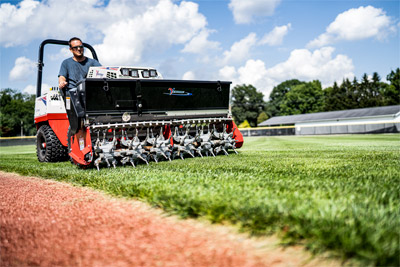
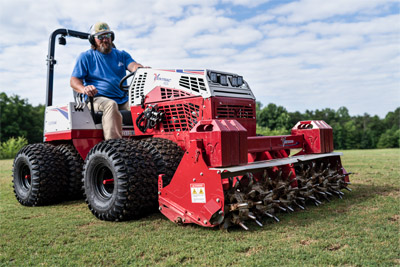
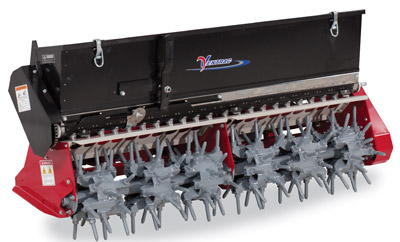
The foundation of every program. The Ventrac Aera-Vator penetrates deep into the root zone using a nine-probe circular motion that fractures compacted soil layers — not just punches a hole through them.
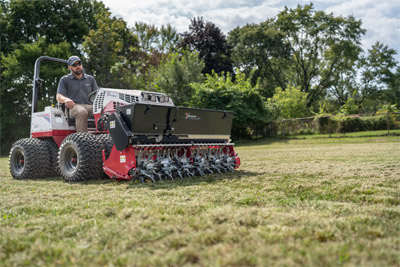
Aeration and seeding in a single pass. A Gandy broadcast seeder mounted directly to the Ventrac deposits seed into freshly fractured soil during the same treatment — no second visit, no second disruption to your schedule.
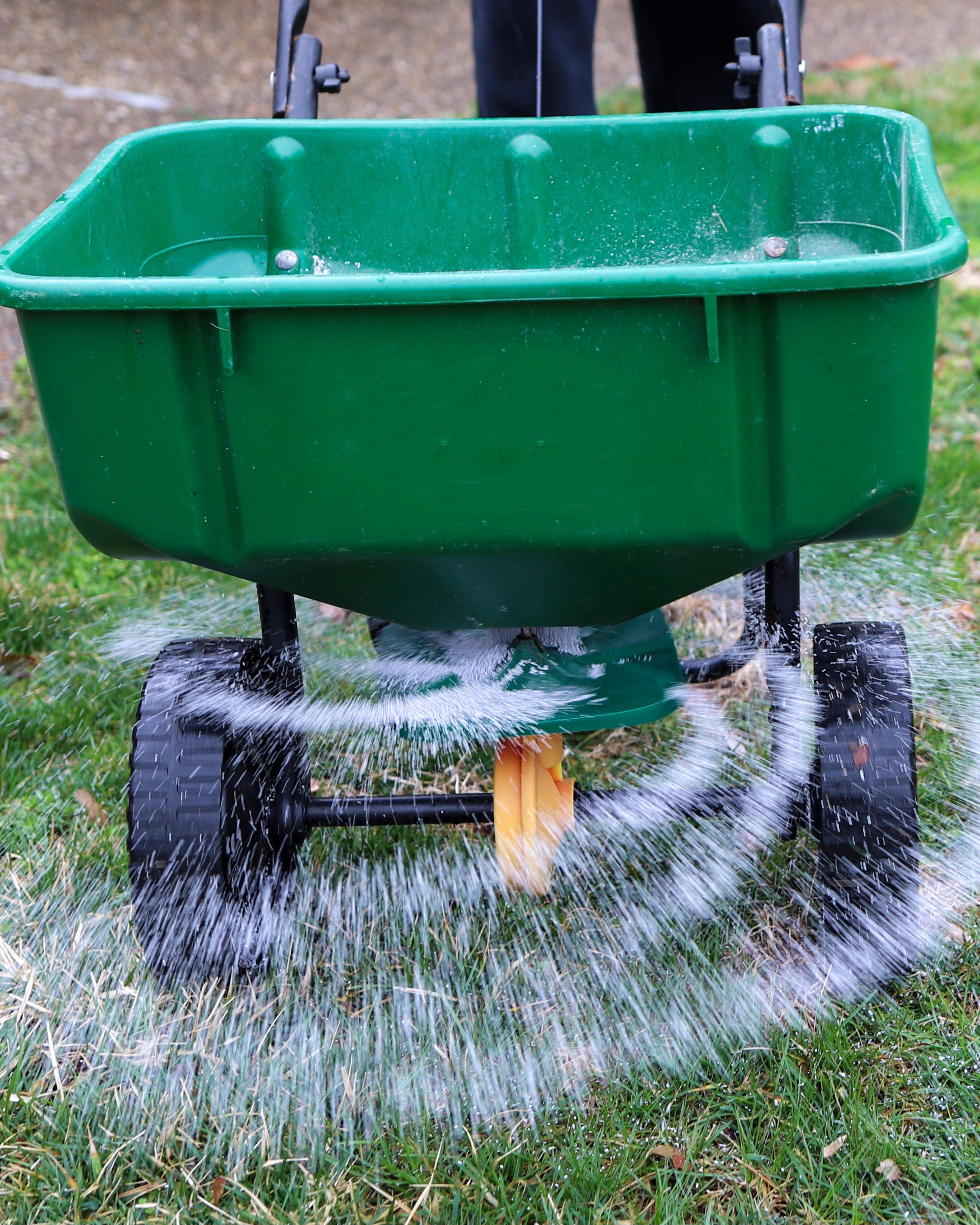
Applied immediately after aeration, fertilizer reaches the root zone directly through freshly opened channels rather than sitting on top of compacted soil. Timing and aeration work together — the results are measurably better than either approach alone.
Not all aeration equipment reaches the same depth or produces the same result. Most aerators available for rent or used by general lawn care companies operate at three to four inches of penetration — enough to address thatch, not enough to break up root-zone compaction.
The Ventrac EA600 Aera-Vator reaches eight to twelve inches, using a nine-probe rotating tine system that fractures compacted layers rather than simply pulling a core. The difference in soil disruption at depth is significant — and visible in turf recovery within one growing season.
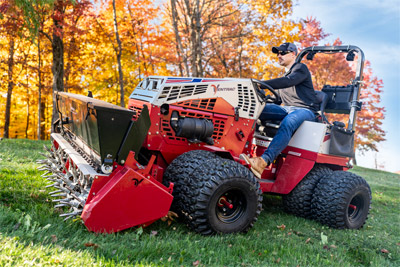
A Gandy broadcast seeder mounts directly to the same unit, allowing aeration and seeding to occur in a single synchronized pass. For field managers with compressed maintenance windows, this matters.
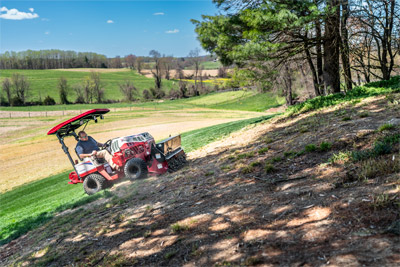
| Tractor Platform | Ventrac 4520 — purpose-built for slope stability and attachment work |
| Aeration Attachment | EA600 Aera-Vator — nine rotating probes, 8–12 inches deep |
| Seeding Attachment | Gandy broadcast seeder — aeration and seeding in one pass |
| Penetration Method | Circular probe rotation — fractures compacted layers at depth |
| Surface Impact | Coreless — no plugs, no cleanup, fields usable the same day |
Points North works exclusively with institutional clients — the directors and managers responsible for natural grass fields under heavy seasonal use. We do not serve residential customers.
If you manage football, soccer, baseball, or softball fields at the high school or college level, your fields are under sustained pressure from practice schedules, game loads, and limited recovery time between seasons.
Programs are timed around your athletic calendar — treatments go in during your low-use windows so fields are ready when the season opens.
Municipal parks fields face multi-use schedules, varying age groups, public accountability, and maintenance budgets that need to stretch across an entire system.
A standing aeration program is one of the most cost-effective investments a parks department can make. Properly maintained turf requires less emergency intervention and lasts longer before renovation is needed.
Points North operates within a 150-mile service radius centered on Jackson, Michigan. That territory covers the majority of Michigan's lower peninsula, the northern tier of Indiana, and northwestern Ohio — a region with hundreds of high school, collegiate, and municipal athletic programs.
Working within a defined region means faster scheduling response, no uncertainty about service availability, and a contractor who understands the seasonal turf conditions in your specific area.
I launched Points North Property Maintenance to focus exclusively on what athletic directors and recreation leaders actually need: natural grass fields maintained to professional safety and playability standards. I chose sports turf intentionally — not as a sideline to general lawn care, but as a dedicated specialization.
Most property maintenance companies spread themselves across residential lawns, commercial grounds, and athletic fields. That approach means athletic directors compete for attention with routine mowing contracts. At Points North, your fields are the only thing we do.
Points North Property Maintenance is fully insured and licensed to operate in Michigan, Indiana, and Ohio.
A growing library for athletic directors and parks & recreation directors — practitioner articles, safety research, and the science behind natural grass. Reviewed and expanded through the season.
Scott Bills, CSFM, on how mismanaged infield mix quietly drains municipal and school budgets — and the practical fix that improves fields while saving real money.
Read the article (PDF) →Reproduced with permission of the author.Scott Bills, CSFM, walks the Theory of Liability and the Standard of Care that every athletic director and facility manager is measured against when a field-condition injury leads to a lawsuit.
Read the article (PDF) →Reproduced with permission of the author.How Michigan State turfgrass research put natural grass in all sixteen 2026 World Cup stadiums — and what it means for school and municipal fields.
Read the feature →More articles added through the season. Have a resource worth sharing? Let us know.
Tell us about your fields and we'll be in touch within one business day.